

From Loom to Goddess: Weaving, Cognition, and Women’s Religious Experience in Ancient Greece, lecture by Ellie Mackin Roberts
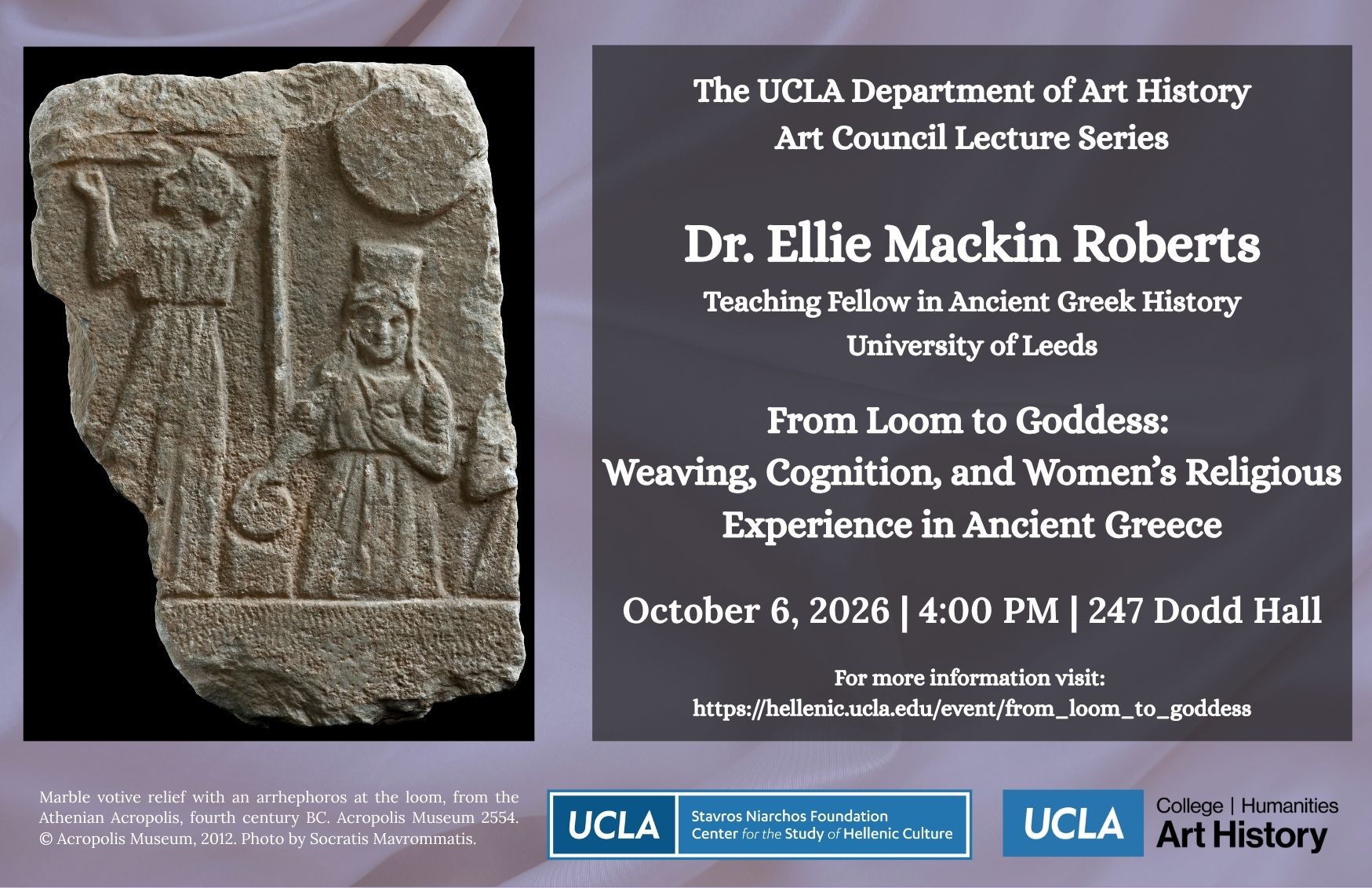
The UCLA Department of Art History Art Council Lecture Series
From Loom to Goddess: Weaving, Cognition, and Women’s Religious Experience in Ancient Greece
Lecture by
Dr. Ellie Mackin Roberts
Teaching Fellow in Ancient Greek History
University of Leeds
October 6, 2026
4:00 PM
247 Dodd Hall, UCLA Campus
An RSVP is required, please reserve your spot here no later than October 1.
Each year, the women of Athens wove a new robe for their goddess. The peplos, presented to the ancient olive-wood statue of Athena Polias at the climax of the Panathenaia, began its life nine months earlier, when the warp was ritually set up on the loom at the festival of the Chalkeia. This paper follows that textile through its full life: from fleece and spindle, through the long months of weaving, into the procession through the city’s streets, and finally onto the body of the goddess herself.
Research in experimental psychology has demonstrated that wearing symbolically meaningful clothing measurably alters cognition – a phenomenon known as ‘enclothed cognition.’ But what of making such clothing? Drawing together cognitive science, sensory archaeology, and the material evidence of ancient textile production, Dr. Ellie Roberts argues that the weaving of sacred cloth constituted what Roberts calls here ‘productive cognition’: a sustained cognitive, sensory, and devotional transformation worked in the maker by the very object she was making. Standing at the warp-weighted loom – hands coated in lanolin, beating the weft into scenes of cosmic battle – the weaver’s thought was shaped, thread by thread, by the garment destined for her goddess.
Tracing the peplos from loom to procession to dedication, and setting it alongside the clothing dedicated by women to Artemis at Brauron, Roberts recovers a dimension of ancient Greek religion that our male-authored sources almost entirely ignore: women’s religious experience as it was lived in the hands, the eyes, and the body. The sacred textile, she argues, was the connective tissue of Greek religion – an object that touched every body in the chain, from maker to carrier to goddess, and transformed each in turn.